



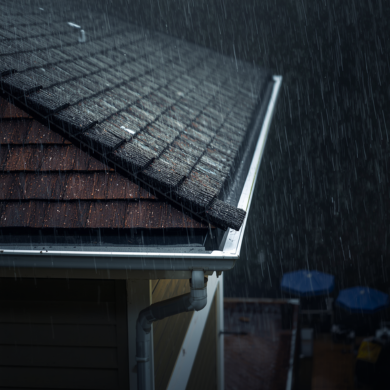
Most guttering issues don’t become obvious until the system is put under real pressure. On installation, everything can appear correct, including straight runs, clean lines, and no visible faults. But when heavy rain hits, weaknesses quickly show themselves, including water overflowing, running down external walls, or bypassing the system entirely. It’s easy to point the finger at the guttering, but in most cases, the problem runs deeper.
More often than not, the issue stems from a mismatch between the roof’s water runoff, its direction, and the capacity of the guttering system to handle it.
If you start anywhere, start with the roof.
A shallow pitch allows water to drain more gradually. The flow is steadier, with less force as it reaches the gutter edge. A steeper pitch behaves very differently. Water accelerates quickly, hitting the gutter with far more volume and momentum, which directly impacts how the system performs.
Two roofs with the same surface area can place completely different demands on the guttering purely because of pitch.
That’s the detail that often gets missed.
Then There’s Volume
The next question is simply: how much water are you dealing with?
You don’t need to overthink it. A rough calculation gets you close enough for most situations. Apply a rainfall factor to the roof area. In the UK, 0.021 litres per second per square metre is a common reference point. So a 100m² roof is putting out around 2.1 litres per second in heavy rain.
That number matters more than the gutter style or material. Because whatever you install has to deal with that flow without backing up.
Where Things Start to Break Down
This is where many guttering systems start to fall short.
A fairly typical setup might include a reasonably sized roof, standard half-round guttering, and one or two downpipes. On paper, it looks adequate, and for light to moderate rainfall, it often is. That’s why the problem can go unnoticed for a long time.
Most rainfall simply isn’t intense enough to stress the system, so everything appears to be working as it should. But during sustained or heavy downpours, the dynamics change, and at that point, it’s no longer about minor inefficiencies; it’s a bottleneck.
Water begins to accumulate in the gutter faster than it can be discharged through the outlets. Downpipes can only carry away so much at a time, and if their number, size, or positioning isn’t sufficient, the system backs up. As the gutter fills, any slight misalignment, restriction, or undersizing is exposed immediately.
Capacity Isn’t Just About the Gutter
There’s a tendency to focus solely on gutter size.
Bigger gutter = better performance.
Sometimes that’s true. But not always.
If the outlets can’t clear water fast enough, the gutter becomes a holding point rather than a flowing system. You end up with the same problem, just in a slightly larger profile.
So it’s not just:
How much water the gutter can carry
It’s also:
How quickly can the system get rid of it
Downpipes Do More Than You Think
You can usually spot an underperforming system by looking at the spacing of the downpipes.
If water has to travel too far before it can exit, it slows down and builds up. That’s when you see localised overflow, often nowhere near the outlet itself.
Adding capacity at the gutter level won’t fix that on its own.
You need to shorten the journey water has to take.
Sometimes that means:
Adding another downpipe
Repositioning outlets
Breaking up long runs
It’s simple, but it makes a big difference.
A Simple Way to Sanity-Check Your Setup
If you’re unsure whether a system is likely to cope, this kind of quick workflow is usually enough to flag problems early:
Step 1: Roof Area
What you're looking for: Total surface draining into each gutter run
Practical outcome: Larger areas = higher water volume
Step 2: Roof Pitch
What you're looking for: Shallow vs steep
Practical outcome: Steeper pitch = faster flow hitting the gutter
Step 3: Estimated Runoff
What you're looking for: Area × rainfall factor (0.021)
Practical outcome: Gives you the flow rate (l/s) to design against
Step 4: Gutter Type
What you're looking for: Half round, deepflow, box
Practical outcome: Must handle calculated flow without backing up
Step 5: Downpipe Count
What you're looking for: Number of outlets per run
Practical outcome: Too few = water builds up before exit
Step 6: Downpipe Position
What you're looking for: Spacing along the run
Practical outcome: Long distances increase overflow risk
Step 7: High Flow Areas
What you're looking for: Valleys, junctions and roof changes
Practical outcome: Consider hoppers or larger outlets
It’s not about getting an exact figure down to the decimal. It’s about spotting where things feel tight, because that’s usually where failure starts.
When a Standard Setup Isn’t Enough
There are situations where standard outlets just don’t cope, such as on larger roofs, with multiple junctions, or in buildings where a lot of water is directed to a single point.
That’s where hoppers come into play.
They provide a place for water to collect and drop more efficiently, rather than forcing everything through a small opening. It takes pressure off the system and helps keep things moving. They’re not always necessary. But when they are, you can usually tell because nothing else quite solves the problem.
Why Overflows Happen
If you boil it down, overflow is just a mismatch.
That mismatch can come from:
- Steep pitch increasing speed
- Large roof area increasing volume
- Undersized gutters
- Too few or poorly placed outlets
Sometimes it’s one of those. Often it’s a combination.
Getting It Right - Without Overcomplicating It
You don’t need to turn this into a full engineering exercise.
A few checks will get you most of the way there:
- How big is the roof feeding each section?
- Is the pitch likely to increase flow speed?
- Can the gutter handle the estimated volume?
- Can water leave the system quickly enough?
If any of those feel marginal, they probably are.
In Conclusion
At Gutter Centre, the systems that perform best aren’t necessarily the biggest or most expensive. They’re the ones that have been thought through properly.
Once the roof pitch, runoff and capacity are aligned, the guttering doesn’t need to work hard. It just works. And importantly, it keeps working when the weather turns.