


Rainwater management is one of the most critical, yet often underestimated, components of a building’s envelope. Effective guttering does more than channel water away; it safeguards façades, prevents damp ingress, reduces structural strain, and supports compliance with performance and sustainability standards. Yet every sector faces unique environmental pressures, design constraints, and regulatory obligations.
At Gutter Centre, we recognise that no two projects are alike. The same aluminium box profile that performs perfectly on a healthcare facility may be over-engineered for a residential build or unsuitable for a heritage restoration. That’s why our specification advice and product range are tailored to meet the precise performance criteria of each industry, ensuring long-term resilience, aesthetic harmony, and regulatory compliance.
Understanding Sector-Specific Demands
Each sector’s guttering system must be designed in response to four key drivers:
- Functional load: roof area, flow rate, and rainfall intensity.
- Environmental exposure: chemical, saline, or particulate corrosion.
- Aesthetic or heritage requirements: architectural style and finish.
- Maintenance access and lifecycle performance: ease of inspection, cleaning, and longevity.
Balancing these factors determines material choice, profile geometry, jointing technique, and finish system, all of which influence compliance with standards such as BS EN 12056-3, BS EN 612, and Approved Document H of the Building Regulations.
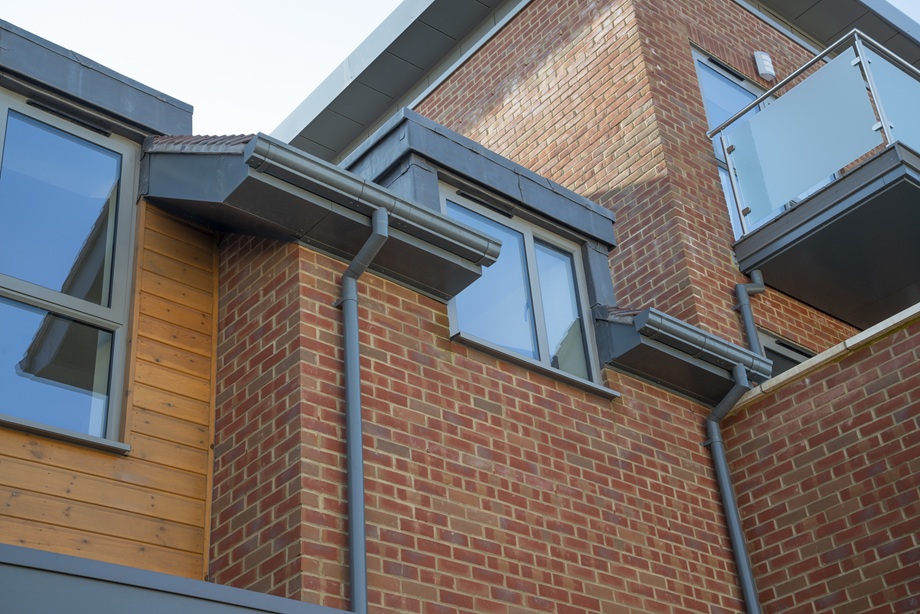
Healthcare: Precision, Hygiene & Controlled Maintenance
Healthcare facilities operate under strict infection-control frameworks. Rainwater systems must resist bacterial growth, withstand frequent external cleaning, and allow access for maintenance without disrupting medical operations.
Aluminium guttering systems are the natural choice here:
- Its non-porous surface prevents biofilm accumulation.
- Continuous welded joints eliminate crevice points where debris can accumulate.
- Polyester powder coatings with anti-microbial additives can further improve hygiene.
For hospitals, clinics, and care homes, we typically recommend half-round or box profiles in pre-coated aluminium with concealed brackets, combining clinical cleanliness with architectural simplicity.
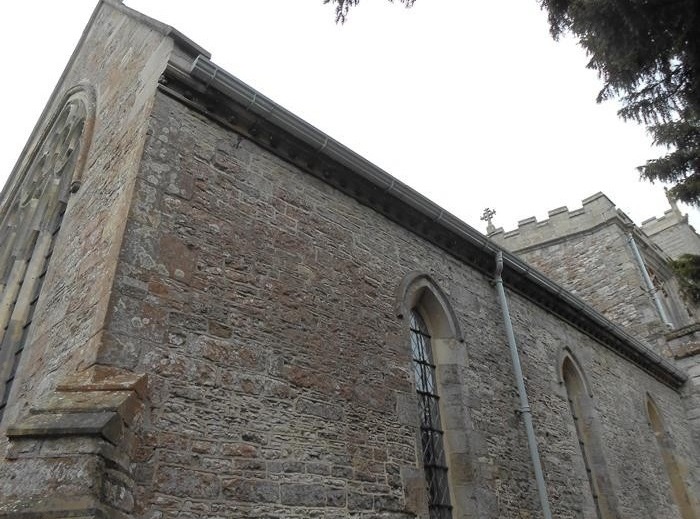
Education: Heritage Integrity & Vandal Resistance
Educational estates often mix modern extensions with listed buildings. Systems must strike a balance between durability and tamper-proofing, while also considering the sensitivity of heritage.
Cast Iron remains unmatched for restoration work due to its historical authenticity, high mass, and acoustic dampening, making it ideal for conservation areas and period school buildings. However,
Heritage Aluminium systems and cast-iron-effect PVC guttering now replicate these profiles, offering a more affordable option.
Where schools face high public access, vandal resistance becomes key. Mechanical joint systems with bolted unions or riveted fittings deter tampering, while coatings ensure a long service life, even in coastal or urban locations.
We recommend cast iron, aluminium or cast iron-effect PVC guttering for educational institutions. If you’d like to speak with a member of our team for further assistance on which guttering system is best suited for your project, please call us on 0330 223 1731 or contact us online.
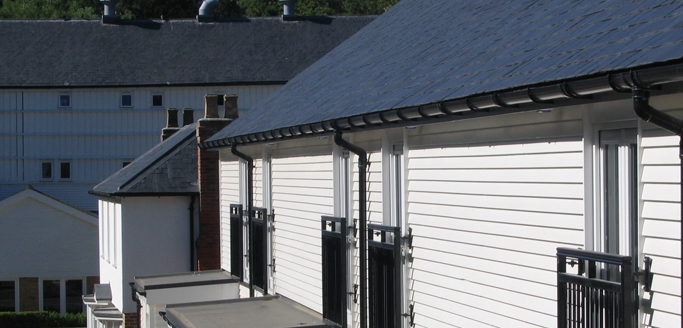
Construction & Temporary Installations: Speed & Adaptability
Temporary and modular site structures need drainage systems that can be fitted rapidly and reconfigured easily. Weight, handling, and connection speed take priority over longevity.
PVC-u and light-gauge aluminium profiles dominate this sector:
- PVC-u clip-fit systems allow tool-free installation and quick dismantling.
- Pressed aluminium half-round systems deliver improved thermal stability for semi-permanent applications.
These materials also comply with BS EN 607 and BS EN 1462, providing predictable flow performance during the construction phase without the cost or complexity of permanent systems.
Commercial Buildings: Architectural Continuity & Weather Integrity
In commercial architecture, guttering is part of the visible design language. The system must integrate with curtain walling, composite cladding, or architectural façades while delivering long-term weather performance.
Commercial aluminium guttering is the sector standard, often custom-fabricated to suit the dimensions of parapets. When enhanced impact resistance is required, for example, in multi-storey retail buildings, galvanised or powder-coated steel can offer superior rigidity and dimensional stability under load.
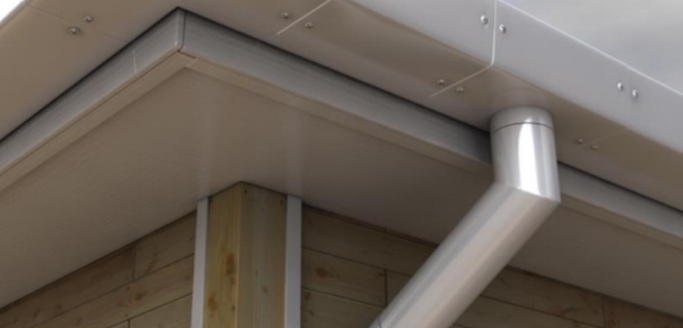
Industrial Buildings: Capacity, Strength & Corrosion Resistance
Industrial and logistics buildings often feature expansive roof spans, which produce high discharge volumes. Systems must handle intense rainfall events while resisting deformation and corrosion.
For these environments, steel or aluminium systems are the preferred choice. Steel provides the tensile strength required for long runs without intermediate supports, while deep elliptical profiles maximise capacity and flow velocity.
In chemically aggressive atmospheres (e.g., near manufacturing exhausts or marine locations), coatings such as Pural, Plastisol, or PVDF can provide corrosion resistance that lasts over 25 years. Heavy-duty fascia brackets and positive fall design (minimum 1:600) further ensure efficient water evacuation under peak load conditions.
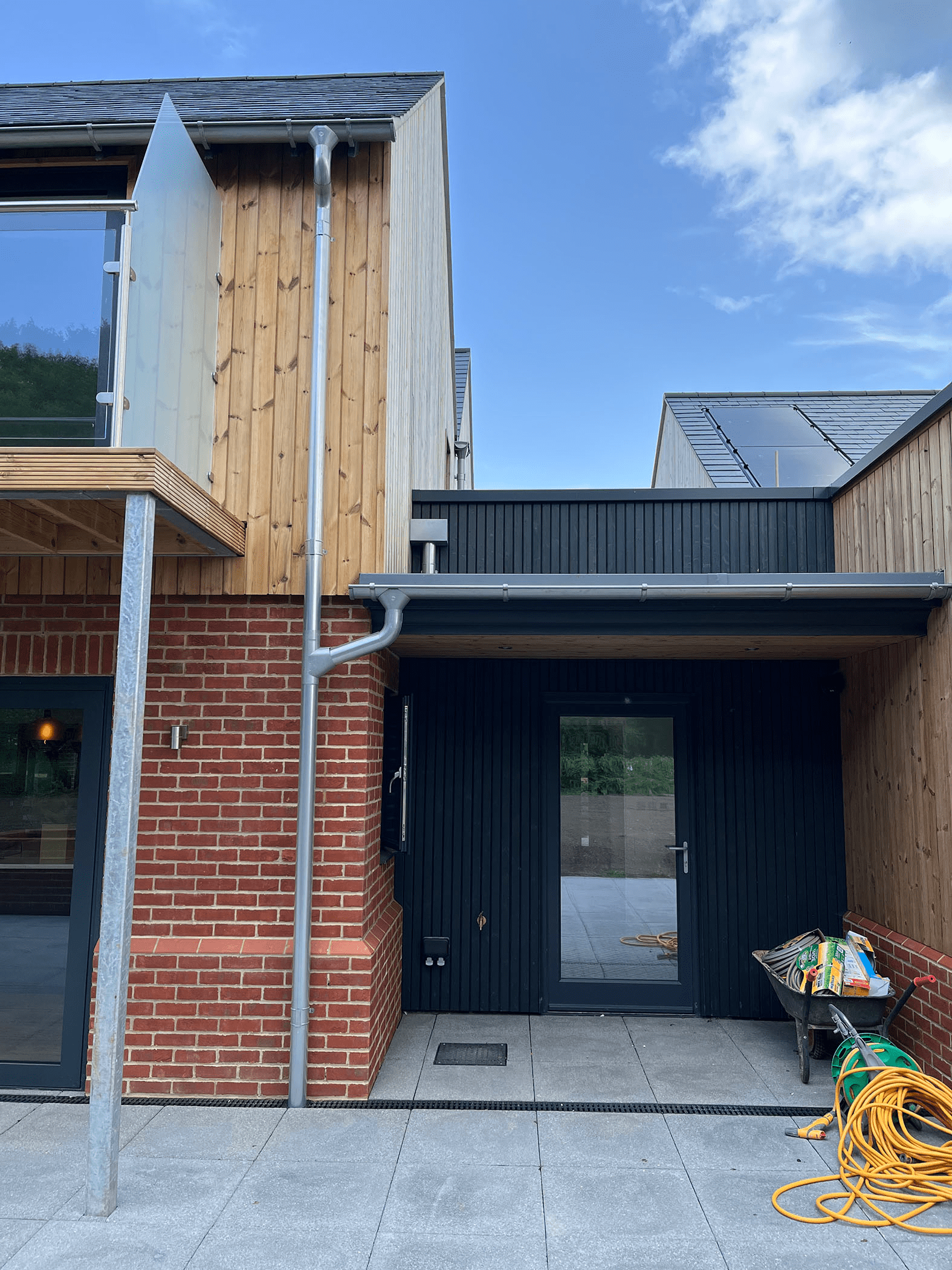
Energy & Utilities: Engineered for Extremes
Energy generation and utility sites are exposed to harsh operational and climatic conditions, as well as chemical vapours, saline mists, UV radiation, and thermal cycling. Systems here must be engineered for performance over decades, not just years.
Powder-coated aluminium and steel systems provide:
- Chemical resistance through high-grade polyester or fluoropolymer coatings.
- Thermal stability across temperature swings from –20°C to +80°C.
- Enhanced corrosion resistance when anodised to AA15 or AA25 standards.
For water treatment facilities or power substations, fully welded aluminium box sections with expansion joints and EPDM seals deliver both structural rigidity and watertight integrity, key to avoiding contamination or structural damage.
Housing Developments: Design Harmony & Sustainable Value
In the residential sector, guttering must perform technically while enhancing kerb appeal. Developers prioritise longevity, low maintenance, and sustainability credentials.
Aluminium systems are ideal for housing developments:
- Expected service life exceeding 40 years (coated) and 60 years (anodised).
- 100% recyclability with minimal embodied energy.
- Custom RAL and BS colour options for design coherence across façades.
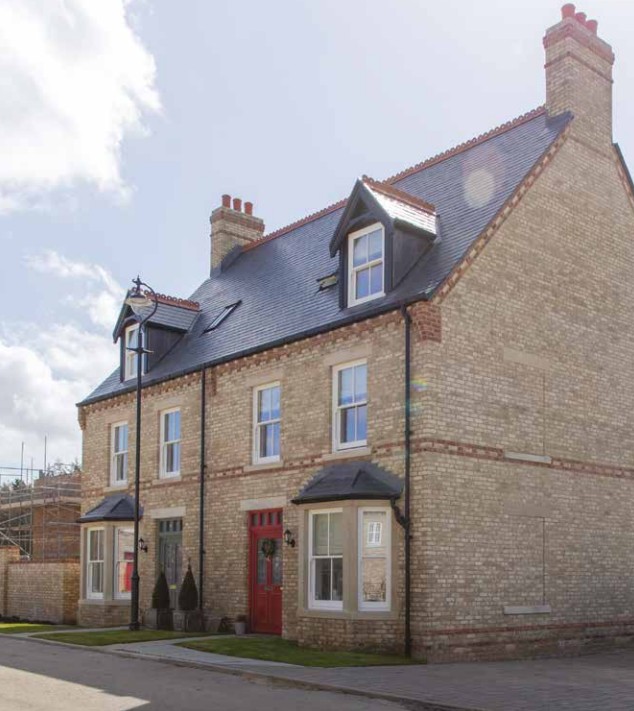
Profiles such as ogee or half-round harmonise with pitched roof aesthetics, while powder coating to Qualicoat Class 2 or 3 ensures fade resistance and UV stability. These attributes make aluminium systems a perfect fit for both large-scale housing and bespoke architectural homes.
Selecting the Right Material: Performance Comparison
| Material | Key Strengths | Ideal Sectors | Lifespan | Notes |
| Aluminium | Lightweight, corroision-resistant & sustainable | Healthcare, housing & commercial | 40-60 years | High design flexibility, low maintenance |
| Cast Iron | Historic authenticity & acoustic damping | Education & conservation | 50-70 years | Heavy, requires painting or coating |
| Steel | High capacity & structural strength | Industrial, commercial & energy | 30-50 years | Requires protective coating |
| uPVC | Low cost & quick installation | Construction & residential housing | 10-20 years | Lower durability |
Regulatory & Compliance Considerations
Every system supplied by Gutter Centre is engineered to align with the following performance and compliance benchmarks:
- BS EN 12056-3: Roof drainage and gutter sizing.
- BS EN 1462: Bracket load performance testing.
- BS 8530:2010: Code of practice for aluminium rainwater systems.
- Approved Document H (Drainage & Waste Disposal): UK Building Regulations.
Selecting the correct profile and material ensures systems not only meet capacity requirements but also contribute to overall BREEAM or LEED scoring through recyclability and durability metrics.
The Gutter Centre Advantage
Every sector has its own operational rhythm, from hospitals that require sterile precision to industrial sites that demand raw strength. Gutter Centre’s engineering-led approach ensures each system is fit for purpose, compliant, and architecturally coherent.
Our technical team collaborates with architects, main contractors, and relevant consultants from early design to completion, offering:
- Full specification support and CAD detail integration.
- Coating system certification and compatibility advice.
- Site-specific bracket load assessments and installation guidance.
With a product portfolio spanning aluminium, cast iron, steel, and PVC-u, we can tailor solutions for virtually any project scale or sector requirement.
Build with Confidence
Whether you’re specifying for a high-capacity industrial roof, a conservation-grade school renovation, or a modern residential development, Gutter Centre delivers guttering systems that perform beyond expectations. Our goal is not simply to supply, but to engineer confidence into every specification.
Contact Gutter Centre’s technical team today for sector-specific guidance, CAD details, and compliance-ready product specifications.
