


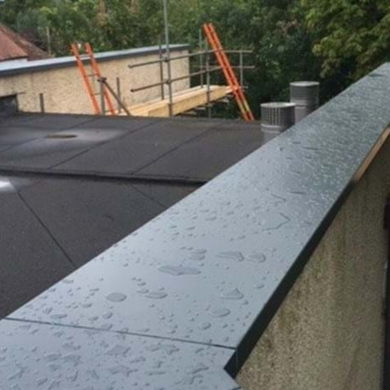
When extending a property, the parapet wall is an important part of the roofline. It helps define the extension's appearance while protecting the wall structure from rainwater and weather exposure. However, the parapet top needs to be properly finished to prevent water from penetrating the wall and causing problems over time.
This is where aluminium coping systems have become an increasingly popular choice.
Lightweight, durable, and available in a wide range of finishes, aluminium coping provides a practical way to protect parapet walls while achieving the clean, contemporary appearance increasingly associated with modern extensions. Systems such as Alumasc Skyline, Alutec Evoke and Trueline offer different options for contractors, builders and specifiers, depending on the project's requirements.
At Gutter Centre, we supply a range of aluminium coping systems to suit different parapet designs, wall widths and installation requirements.
What Is Aluminium Coping?
Aluminium coping is a protective capping system fitted over the top of a parapet wall. Its primary purpose is to prevent rainwater from penetrating the wall head and to direct water away from vulnerable surfaces.
Unlike traditional masonry, stone, or concrete coping, aluminium provides a lightweight solution that can be manufactured to suit the building's dimensions and design.
The result is both functional and architectural. A well-designed coping system provides weather protection while creating a clean edge to the roofline, making it particularly suited to contemporary extensions.
Why Use Aluminium Coping on an Extension?
Extensions often incorporate flat roofs and parapet walls, creating a modern, relatively simple roofline. However, these designs can leave the parapet top particularly exposed to rainfall.
Choosing the right coping system helps address this by providing a continuous, weather-resistant finish.
1. Reliable protection against water ingress
The main purpose of parapet coping is to protect the wall from water.
An appropriately designed aluminium coping projects beyond the wall face, helping to prevent rainwater from running directly down the masonry, render or external finish. Sloping profiles can provide an additional advantage by directing water towards the roof and drainage system.
For an extension, where the parapet may be directly exposed to prevailing weather, this is an important consideration.
2. Lightweight and durable
Aluminium combines relatively low weight with good durability, making it practical for both new-build extensions and refurbishment projects.
It is also naturally resistant to corrosion and does not require the same level of ongoing maintenance associated with some traditional materials. This makes aluminium particularly attractive for creating a long-lasting roofline with minimal upkeep.
3. A clean, contemporary finish
Modern extensions frequently use simple architectural forms, large areas of glazing and minimalist rooflines. A bulky or visually heavy coping can work against this aesthetic.
Aluminium coping offers a much cleaner finish, with concealed fixing systems available on several product ranges. Powder coating also allows the coping to be coordinated with other elements of the building, including windows, doors, fascias and other roofline products.
4. Suitable for different parapet designs
No two extensions are necessarily the same. Wall widths, roof construction, angles and architectural details can all vary.
Aluminium coping systems can therefore provide greater flexibility than standard masonry coping. Depending on the system, profiles can be manufactured or specified to accommodate different wall widths, corners, junctions and other project-specific requirements.
Bespoke Aluminium Coping: Dog-Legs, Variable and Irregular Angles
Not every parapet wall runs in a straight line, and standard coping lengths don't always suit every corner, junction or change of direction. That's why Gutter Centre also offers a bespoke aluminium coping fabrication service, manufacturing dog-leg coping, mitred corners, and coping with variable or irregular angles to match the exact geometry of the roofline.
Rather than adapting standard profiles on site, each piece is purpose-made off site to the parapet's true dimensions, ensuring a precise, weathertight fit at every joint. For contractors and specifiers working on extensions with non-standard wall widths, awkward corners or complex rooflines, this bespoke fabrication capability helps achieve a genuinely pristine, professional finish from end to end.
Alumasc Skyline Aluminium Coping
One of the key aluminium coping systems available from Gutter Centre is Alumasc Skyline.
The Skyline system is designed to provide a weatherproof capping to upstand parapets on both flat and pitched roofs. A key feature is its concealed strap fixing system, which avoids penetrating the coping itself while allowing ventilation over the top of the wall.
For extension projects, Skyline offers three particularly useful options: Flat Coping, Sloping Coping and Capping Trim.
Fire performance: Solid aluminium and single-skin aluminium sheet are classified as non-combustible. Powder-coated aluminium using Interpon D1000 and D2000 series coatings has been tested to BS 476 Parts 6 and 7 and meets the criteria for Class 0 under the Building Regulations.
Polyester powder coating: Manufactured to BS EN 12206-1:2004, in accordance with the architect’s requirements.
Wind load calculations: Wind loads are calculated in accordance with BS 6399: Part 2.
BBA accreditation: Polyester powder coating is BBA accredited.
Wind uplift: Systems are tested for wind uplift in accordance with EOTA TR005.
Skyline Aluminium Flat Coping
Skyline Flat Coping provides a clean, horizontal finish to the top of a parapet wall. It is particularly suited to flat roof extensions where a simple, contemporary roofline is required.
The concealed fixing approach means fixings are not visible on the surface of the coping, helping to maintain the clean appearance of the finished roofline. It is suitable for both new-build and retrofit applications.
Skyline Aluminium Sloping Coping
Where additional water run-off is desirable, Skyline Sloping Coping provides an inclined profile designed to direct rainwater back towards the roof area and drainage outlets.
The system incorporates an engineered bracket with an integral fall, while the coping itself uses the same non-penetrative fixing principle. The sloping profile can therefore provide a particularly useful solution for exposed parapets where managing surface water is a priority.
Alumasc operates a quality management system certified to ISO 9001:2008.
The Alumasc manufacturing site in Burton Latimer is certified to the ISO 14001:2004 Environmental Management Standard.
Alumasc’s aluminium rainwater systems are covered by British Board of Agrément (BBA) Certificate No. 86/1671, including certification for the polyester powder coating of aluminium rainwater and Skyline products for performance and colour fastness.
Skyline Aluminium Capping Trim
For narrower parapet walls, Skyline Aluminium Capping Trim provides an alternative solution. It is designed for flat roof parapets approximately 75mm to 180mm wide, making it useful where a conventional wider coping profile is not appropriate.
This gives contractors and specifiers greater flexibility when selecting a coping system based on the finished wall thickness. Skyline is also available in a range of powder-coated finishes, allowing the coping to complement the extension's broader design.
Alutec Evoke Aluminium Coping
Another option for extension parapets is Alutec Evoke.
Evoke is designed with durability and weather performance in mind, using a concealed fixing strap system to create a secure finish without visible fixings on the face of the coping. Gutter Centre supplies Evoke as part of its aluminium coping range for projects that require a durable, high-quality parapet solution.
This makes Evoke particularly worth considering, where the coping needs to combine a strong structural solution with a clean architectural appearance.
For contractors working on higher-specification residential extensions or commercial projects, the availability of different panel thicknesses and powder-coated finishes can also provide greater scope to match the coping to the building's requirements.
Trueline Aluminium Coping
Trueline aluminium coping provides another flexible option for finishing parapet walls.
The Trueline coping system is designed to provide a cost-effective and easily installed finish, with no visible fixings once installed. Its fixing strap also allows ventilation at the top of the wall, while the system can be designed to suit different project requirements.
One of the advantages of Trueline is its flexibility. Copings can be manufactured to suit specific applications rather than relying solely on standard configurations, which can be particularly useful when an extension incorporates unusual dimensions, corners or architectural details.
Trueline copings can also be polyester powder coated in a colour of choice, providing further flexibility when matching the extension's external finishes.
Aluminium Coping vs Traditional Parapet Coping
Aluminium isn't the only option for finishing a parapet wall, but it offers several advantages for modern extension projects.
Traditional stone or concrete copings can provide a robust finish, but they are generally heavier and can create a more substantial visual appearance. Aluminium offers a lightweight alternative with a slimmer, more contemporary aesthetic.
It can also be powder coated in a variety of colours and manufactured to suit specific dimensions, giving architects, builders and homeowners greater flexibility when designing the finished roofline.
The key consideration is not simply the material itself, but selecting a properly designed coping system suitable for the wall construction, dimensions, and exposure of the building.
Flat or Sloping Aluminium Coping: Which Should You Choose?
The choice between a flat and sloping coping will depend on the design and requirements of the extension.
Flat coping can be a good choice where a simple, minimalist roofline is the priority. It creates a clean horizontal line and works particularly well with contemporary flat roof designs.
Sloping coping introduces a fall to help direct rainwater towards the roof and drainage system. This can be beneficial where managing rainwater at the parapet is a particular consideration.
For narrower walls, capping trim may provide a more appropriate solution than a conventional coping profile.
When specifying the system, it is important to measure the finished wall thickness, including any render, cladding or other external finishes. This determines the appropriate coping size and ensures the fixing system is compatible with the wall construction.
A Practical Choice for Modern Extensions
The growing use of flat roofs and parapet walls in contemporary extensions has increased the need for reliable, visually clean roofline solutions. Aluminium coping meets both requirements. It provides important weatherproofing while also enhancing the overall appearance of the extension.
With options including Alumasc Skyline Flat Coping, Skyline Sloping Coping, Skyline Aluminium Capping Trim, Alutec Evoke and Trueline, there are solutions available for a wide variety of parapet designs and project requirements.
For homeowners, builders and contractors, the combination of durability, low maintenance, concealed fixings and flexible finishes makes aluminium coping a practical choice for protecting and completing an extension parapet wall.
Find the Right Aluminium Coping for Your Project
Gutter Centre supplies a range of aluminium coping systems, including Alumasc Skyline, Alutec Evoke and Trueline, with options for different parapet widths, profiles and finishes.
Explore Gutter Centre's Aluminium Coping Range
If you're unsure which coping profile or size is suitable for your extension, the Gutter Centre team can help you identify the appropriate system for your project.
